Archival photography · Sources & licences
Nokia’s most memorable phones were rarely neutral. Even simple models had recognizable key arrangements, faceplates, proportions and screen graphics. The company built at enormous scale, yet many devices still communicated a specific character before they were switched on.
The phone as an everyday tool
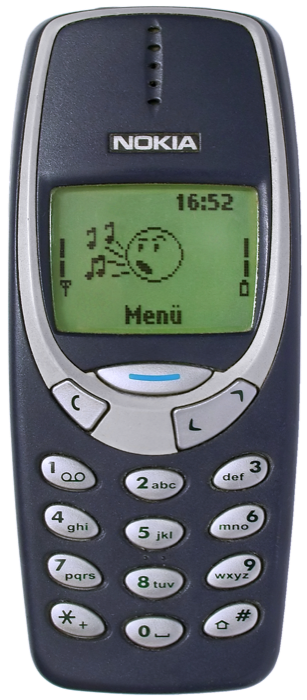
The Nokia 3310, introduced in 2000, is remembered less for novelty than for coherence. Its rounded body protected the monochrome screen, the central navigation key made the menu hierarchy legible, and replaceable covers let a mass-market object become personal. Durability was not only an engineering quality; it was part of the visual language.
That approach matched how phones were used. A device lived loose in a pocket or bag, was operated one-handed and needed to survive daily impacts. Large physical targets and strong contrast reduced the need to look carefully at the screen.
When a mechanism explained the feature
The 7650, released in 2002, used a sliding body to reveal its keypad. The movement made room for a larger screen and also marked a transition: this was a phone built around images and software as much as calls. Opening it was an interaction with meaning, not decoration added after the fact.
Nokia continued to test unconventional layouts. The N-Gage treated gaming as the organising idea. The fashion-oriented 7280 removed the conventional number pad and turned the handset into something closer to an accessory. These experiments were polarising, but each one made its intended use visible.
The N95 and the multi-purpose object
By 2007, the Nokia N95’s two-way slider captured the pressure placed on advanced phones. Slide one way for a keypad; slide the other for media controls. GPS, a capable camera, music and web access all competed for space before a large touchscreen could absorb nearly every control.
The hardware did not merely contain the interface. Its movement revealed which mode the phone was in.
Why these designs still matter
Nokia’s 2000s catalogue shows how a family of products can remain recognizable without making every model identical. Shared menu logic, typography and construction established trust. Shape, colour and mechanisms gave individual devices a job and an audience.
Modern phones gain flexibility from a blank screen. Older Nokia phones offer the opposite lesson: committing physical space to an action can make that action clearer, faster and more memorable.